Are Dead Trees Dangerous? When You Need Removal
Worried about a dead tree in your yard? Learn how to tell if it’s truly dangerous, when you can safely wait until winter, and what “safe enough” removal options look like.
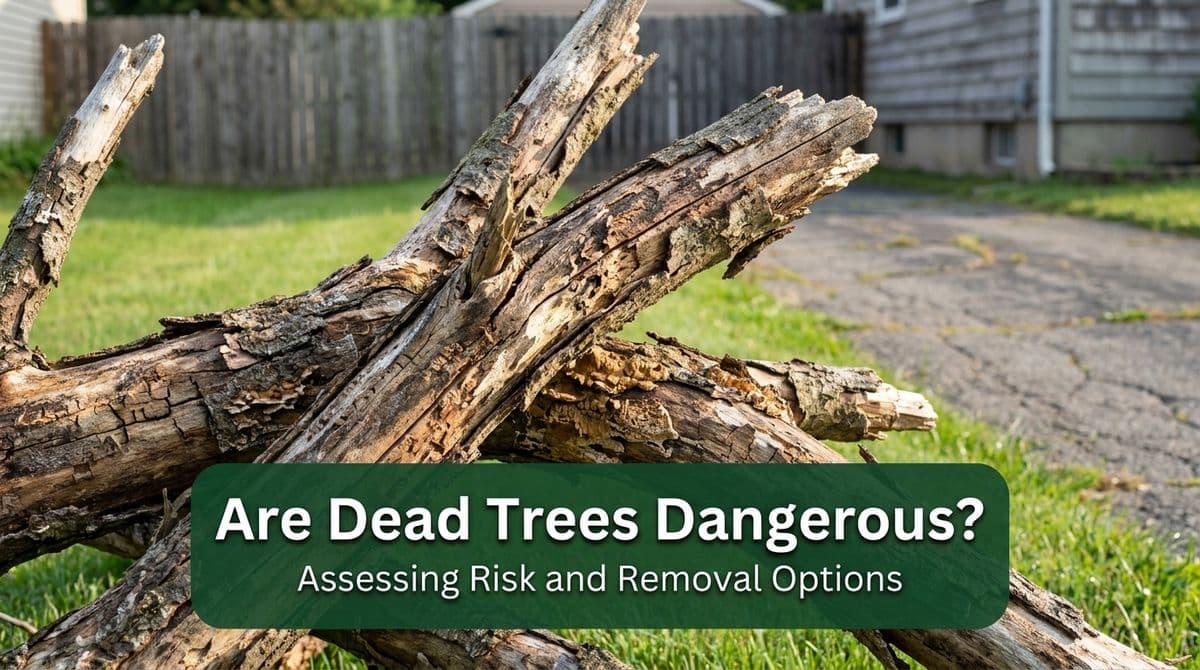
Are Dead Trees Always Dangerous?
We recently got a call from a homeowner — let’s call her Sarah — who had two big dead oaks in her backyard. She told us, “They’re totally dead from what I can see, and I’m just afraid eventually they’ll fall down. But if they’re safe enough, I’d rather wait until winter when it might be cheaper.”
Sarah also didn’t care about the stumps. In her words, “Just cut them down until they’re no longer a safety hazard. You can leave the stump or some trunk as long as it doesn’t endanger anything.”
We hear some version of Sarah’s question all the time: Are dead trees automatically dangerous, or can I wait on removal? The honest answer is: it depends. Let’s walk through how we look at a dead tree and decide whether it needs immediate removal or if it’s “safe enough” to wait.
Step 1: What Could the Tree Hit If It Fails?
The first thing we consider on a site visit is what we call the “target zone” — what’s under or near the tree if it falls or drops large branches.
Stand back and imagine the tree suddenly coming down in any direction. Ask yourself:
- Could it hit your house, garage, fence, or shed?
- Is it near power lines or service drops?
- Is there a deck, patio, playset, or frequently used area below?
- Would it hit a driveway, street, or sidewalk where people or cars are often present?
If the answer to any of these is “yes,” that tree jumps higher on the priority list. Even a smaller dead tree over a play area or driveway may be more urgent than a big one that only threatens a back corner of the yard.
Step 2: Is the Tree Truly Dead or Just Struggling?
Sarah was pretty confident her oaks were dead: no leaves, no buds, and the bark was flaking off. We always verify, but you can do a quick check yourself:
- Scratch test: Lightly scratch a small patch of twigs or a thin branch. Green and moist under the bark = still alive. Brown, dry, and brittle = dead.
- No buds or leaves in season: In spring and summer, a totally bare tree surrounded by leafy neighbors is a red flag.
- Large dead branches in the crown: If most or all major limbs are dead, the tree is functionally done.
Once we confirm a tree is dead, the clock is ticking — wood only gets weaker over time. But that doesn’t mean you must remove it tomorrow in every case.
Step 3: How Structurally Compromised Is It?
Some dead trees are still fairly solid for a while; others are one storm away from coming down. When we’re evaluating whether you can wait until winter, we look for:
- Leaning: A recent or increasing lean, especially toward a target, is a warning sign.
- Root and trunk decay: Mushrooms or conks on the trunk or at the base, soft or hollow-sounding wood, big cavities, or major cracks are serious concerns.
- Dead or broken limbs over targets: Large “hangers” or cracked limbs over a house, patio, or play area can be hazardous even if the trunk is still fairly sound.
- Species and age: Some species hold together longer; others (and very old trees) become brittle quickly after dying.
If a dead tree is badly decayed at the base, has significant cracks, or is obviously unstable, we’ll usually recommend sooner-than-later removal rather than waiting for winter discounts.
When It’s Usually Safe to Wait Until Winter
With Sarah’s trees, her big question was, “Can I safely leave the dead oaks until winter if they’re not a hazard?” That’s a smart way to think about it. In many cases, waiting makes sense if:
- The tree is well away from structures, power lines, and play areas.
- There’s no obvious lean toward a target.
- The trunk feels relatively solid at the base with no large cavities, major cracks, or extensive soft, punky wood.
- There are no huge dead limbs hanging over places people spend time.
In those scenarios, we’ll often tell homeowners they can safely schedule for late fall or winter. As we mentioned to Sarah, being flexible on timing sometimes opens the door to more cost-effective scheduling, because winter can be a slower season for certain types of tree work in our area.
What Does “Safe Enough” Look Like?
“Safe enough” doesn’t mean zero risk — that doesn’t exist with trees. It means the risk is low enough that most people feel comfortable waiting a bit. In practical terms, that usually means:
- The tree isn’t showing urgent failure signs (major cracking, severe lean, badly decayed base).
- If it did come down, it would likely only hit lawn, garden, or natural areas, not people or property.
- You’re comfortable with the small remaining risk between now and the scheduled removal date.
When we walk a property, we talk this through with the homeowner so they understand exactly what we’re seeing and why we’re recommending either immediate work or a wait-until-winter plan.
Do You Have to Remove the Stump or Whole Trunk?
Just like Sarah, many homeowners tell us, “I don’t need stump grinding. Just make it safe.” That’s completely fine. Here are your basic options:
- Full removal with stump grinding: Cleanest look, easiest to replant or re-landscape. Higher cost, because stump grinding is a separate service.
- Cut to a low stump: We remove the tree and leave the stump a few inches above ground. This is usually the most budget-friendly option and is what we recommended to Sarah since safety was her main concern.
- Leave a taller “wildlife snag” in a safe spot: In back corners away from people and structures, some homeowners like to leave a portion of the trunk standing for birds and other wildlife. This only works if there’s no realistic target zone and the remaining trunk is still structurally sound enough for its new, reduced height.
You can always decide later to have the stump ground out or the remaining trunk shortened more. Many of our clients phase the work this way to spread out costs.
When You Shouldn’t Wait
If you’re looking at a dead tree and notice any of the following, it’s worth getting a professional opinion quickly:
- A sudden or noticeable lean, especially after a storm.
- Large cracks in the trunk or major limbs.
- Extensive mushrooms, conks, or soft, crumbly wood at the base.
- Dead branches hanging over a house, driveway, sidewalk, or area where people regularly spend time.
- The tree is already shedding big limbs in moderate winds.
In those cases, waiting for a “better season” or potential discounts usually isn’t worth the risk. We’ll be honest with you about that, even if it means recommending faster work that doesn’t fit the ideal budget window.
Not Sure About Your Tree? Here’s Our Advice
If you’re like Sarah and staring at one or two dead trees, the best next step is a simple walkthrough with a pro. When we visit, we:
- Confirm whether the tree is truly dead or just stressed.
- Evaluate targets, structural issues, and decay.
- Explain whether we feel you can safely wait or should schedule removal sooner.
- Go over options like leaving a stump or partial trunk to match your budget and goals.
The goal isn’t to scare you into immediate work — it’s to give you clear information so you can decide what “safe enough” looks like for your family and property.