Bucket Truck vs. Climbing: Safest Way to Remove a Tree
Wondering if your large tree should be removed with a bucket truck or climber on ropes? Here’s how we decide the safest method for your yard and home.
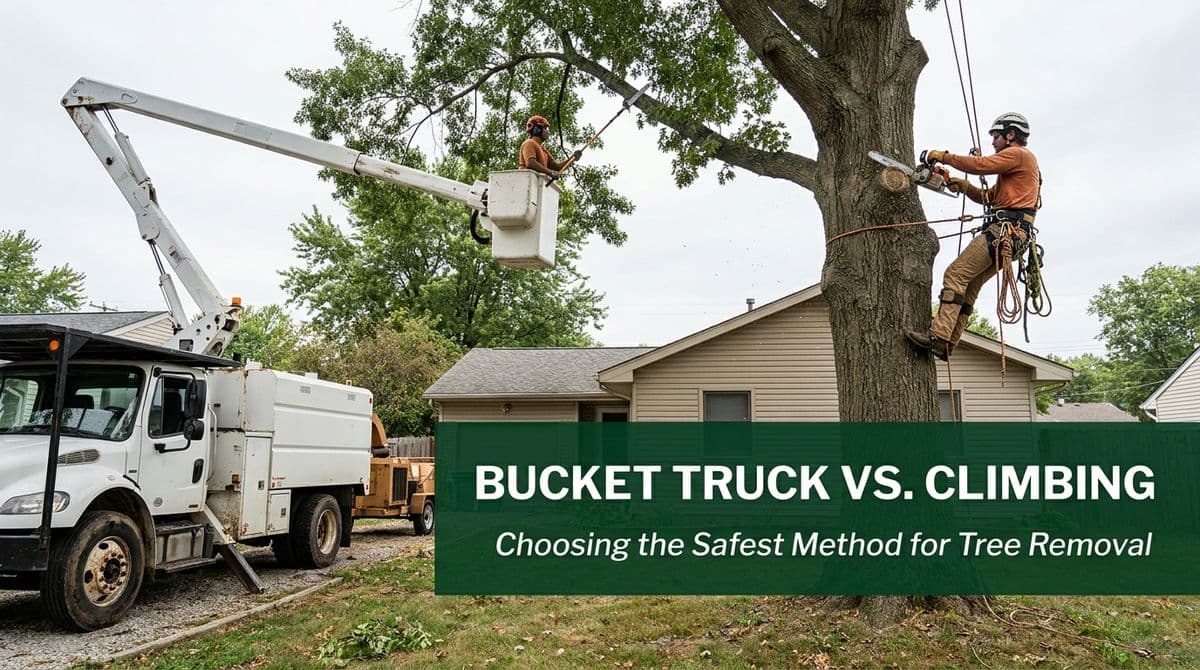
Bucket Truck vs. Climbing: How We Decide the Safest Way to Remove Your Tree
We recently got a call from a homeowner — let’s call him Mark — who had a big old silver maple in his front yard that had been damaged in a tornado years ago. He’d been nursing it along with regular trimming, hoping it would bounce back, but a city crew finally told him what he already suspected: the tree was at the end of its life and needed to come down.
Mark’s biggest question for us wasn’t just about price. It was about how we’d remove it. He’d seen other companies send climbers up on ropes and saddles and told us, “I don’t really want people hanging from ropes in that tree. Do you use a bucket truck to get up high?”
That’s a question we hear a lot, and the honest answer is: sometimes bucket, sometimes ropes — it depends. Our job is to choose the safest, most controlled approach for your tree and your property, not just what’s most convenient for us.
Two Main Options: Bucket Truck or Climbing with Ropes
When we look at a large tree removal, we’re usually deciding between:
- Using a bucket truck (also called a cherry picker or aerial lift)
- Sending a professional climber up on ropes and saddle
Both methods are safe when done by trained pros with the right gear. The real difference is which is safer and more practical for that specific tree in that specific spot.
In Mark’s case, his silver maple was in the front yard on a corner lot, right by the house and close to the street. It sounded like a great candidate for our bucket truck — but we never make that call until we’ve actually seen the site.
When a Bucket Truck Is the Best Choice
A lot of homeowners assume the bucket truck is always the “safer” option, and often it is. We typically lean toward the bucket when:
- We have good access – There’s room to get the truck into position without driving over septic systems, underground utilities, or delicate landscaping.
- The ground is solid – The soil isn’t too soft, steep, or unstable for the truck’s outriggers.
- There’s a clear work zone – Overhead wires, fences, and structures won’t prevent the boom from reaching into the canopy.
- We need extra stability – For some compromised trees, keeping the arborist in the bucket instead of on the trunk can be a big safety advantage.
With a bucket truck, our arborist is working from a stable platform. That can mean:
- Less movement and flex than climbing in the canopy
- Faster, more efficient cutting in many cases
- An easier time managing and rigging large limbs safely
But there’s a catch: a bucket truck is big, heavy equipment. If we can’t safely get it where we need it, or if it risks damaging your yard or underground systems, it’s simply not the right choice.
Why We Sometimes Prefer Climbers on Ropes
In our call with Mark, we explained that we also have highly trained climbers who “live” in those saddles and ropes. It may look scary from the ground, but modern climbing and rigging methods are extremely controlled when done by pros.
We actually prefer sending a climber instead of a bucket truck when:
- Access is tight – Backyards with narrow gates, tight side yards, or obstacles that a truck can’t navigate.
- The tree’s structure demands it – Sometimes, being inside the canopy gives the climber better control over how and where pieces are cut and lowered.
- We want to minimize lawn or hardscape damage – No heavy truck ruts in the yard or risk to driveways and sidewalks.
- The tree is partially compromised – Climbing allows us to test and trust specific portions of the tree as we work, using backup anchors and rigging.
Professional climbers use:
- Redundant rope systems and harnesses rated far above expected loads
- Rigging gear to lower large limbs in small, controlled pieces
- Careful planning to avoid putting weight on dead or hollow sections
To a homeowner like Mark, “hanging from ropes” sounds risky. From our side, when it’s done by a certified arborist, it’s often the most precise, adaptable way to work in a complex tree.
How We Decide: Safety First, Then Property Protection
When we come out to give a quote like the one Mark requested, we’re not just counting branches. We’re running through a mental checklist to decide on method:
- Tree health – How much sound wood is left? Is the trunk decayed? Are there large dead leaders?
- Location – How close is the tree to the house, roof, deck, fence, or neighbor’s property?
- Targets below – What absolutely must not be hit: roofs, power lines, AC units, cars, playsets?
- Access – Can we safely get a bucket truck where we want it without causing damage?
- Overhead hazards – Power lines, service drops, or other utilities in the way?
After that, we match the method to the situation. Sometimes we’ll even combine approaches — using a bucket for part of the tree and climbing the rest, or using a smaller lift plus rope work.
What You Can Ask Your Tree Company
If you’re in a situation like Mark’s and trying to decide who to hire, here are a few smart questions to ask:
- “Will you use a bucket truck, a climber, or both — and why?”
- “How will you protect my house, yard, and driveway?”
- “What’s your plan if you find more decay once you start cutting?”
- “Are your climbers and operators trained and insured?”
The right company should be able to walk you through their plan in plain language and explain why they’re choosing a bucket or ropes for your specific tree, not just give a one-size-fits-all answer.
Need a Large Tree Removed? Here’s How We Handle It
With Mark’s silver maple, our next step after that initial call was to send an arborist out within 24–48 hours to inspect the tree in person, evaluate access, and then put together a detailed, line-by-line quote. We offer the same process to every homeowner: you see exactly what’s included, and we explain the method we’ll use and why.
If you’ve got a large, aging, or storm-damaged tree and you’re unsure about bucket truck vs. climbing, we’re happy to come out, take a look, and walk you through the safest option for your yard.